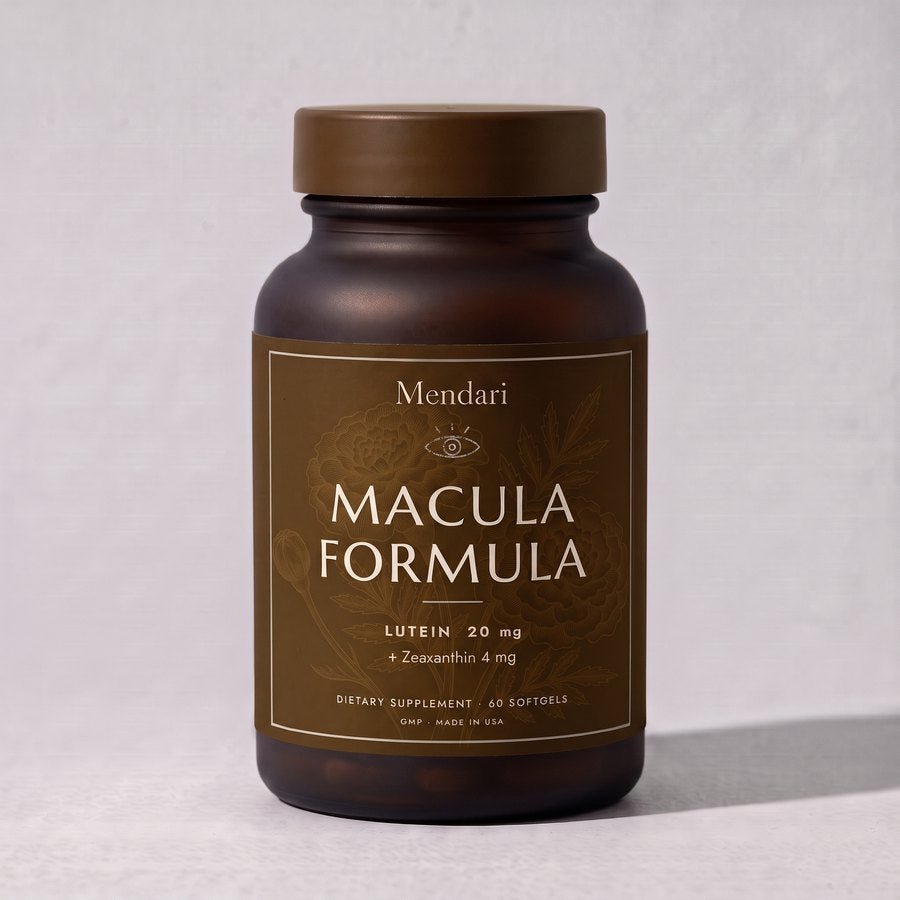
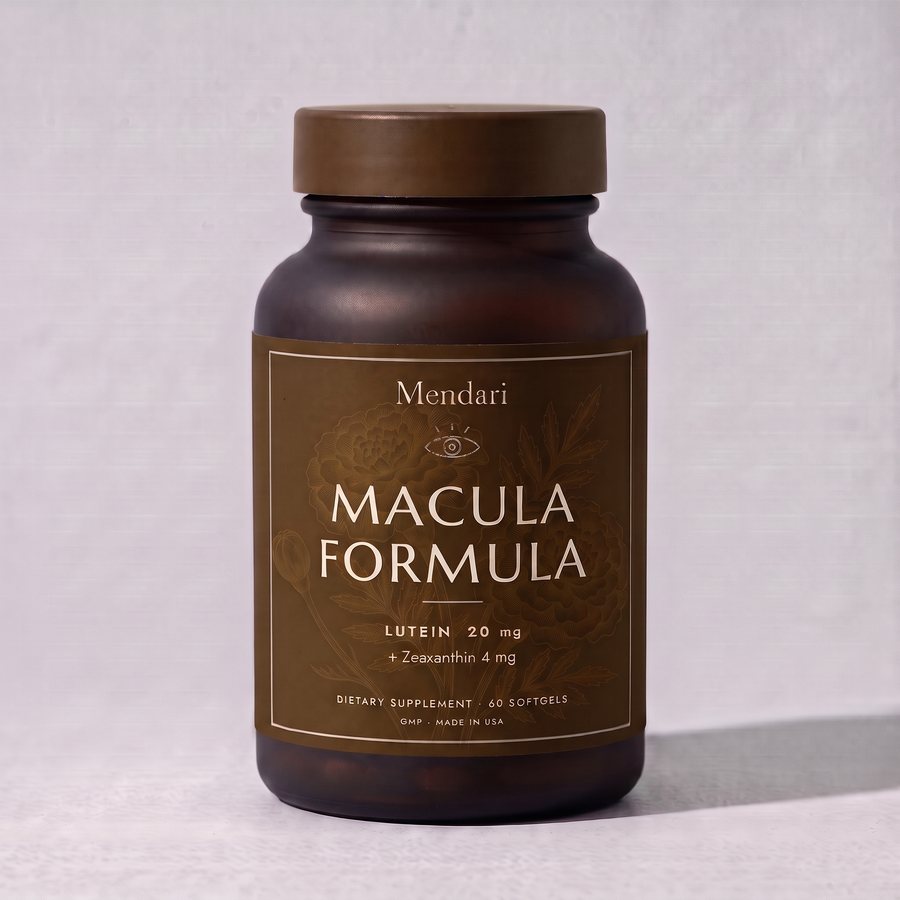
One small softgel a day for sharper reading and night driving, with 2x the lutein and zeaxanthin in AREDS2, studied to help slow macular degeneration.*
Studied to Slow AMD*
Read Small Print Easier
Night Driving Confidence
See Faces in Detail
No Zinc Nausea
Made in the USA
Choose your supply
Couldn't load pickup availability
GIFTS UNLOCKED
Locked
$19.99FREE Magnifier
+
Locked
$9.99FREE Grid Magnet
+
Locked
$39.99FREE Reading Lamp
90-Day Money-Back Guarantee
Made in USA
Free shipping
Ships next day
How to take it
Take 1 softgel a day with a meal. Lutein absorbs best with a little fat, so take it with breakfast or lunch.
Keep the bottle by your coffee or in your weekly pill organizer. One bottle lasts 60 days.
What’s inside
Per softgel: Lutein 20 mg and Zeaxanthin 4 mg, from marigold. 60 softgels, a 60-day bottle. GMP. Made in the USA.
No zinc. No beta carotene. No fish oil, so no fishy burps. One small softgel.
Shipping & returns
Free US shipping on every order. Ships from the USA in 1 business day, tracking to your inbox.
Returns are covered by the 90-day guarantee. Nothing to send back.
The 90-day guarantee
Use every bottle for 90 days. If you're not seeing sharper contrast, email us and we refund every bottle, even if it's empty, with nothing to send back.
An ophthalmologist and an optometrist on lutein and your macula, in 3 short clips. Neither works for us. Then read 12 studies.
Watch: 2 eye doctors on lutein
Marc Shomer, MD, PhD, board-certified ophthalmologist, on lutein and zeaxanthin (his own channel).Joseph Allen, OD, optometrist, on macular pigment and lutein dose (Doctor Eye Health; video sponsored by a lutein supplier).Joseph Allen, OD, optometrist, on the lutein dose studied and night glare (Doctor Eye Health; sponsored by a lutein supplier).
National Eye Institute
AREDS2: the big government eye trial
AREDS2 was a National Eye Institute trial in 4,203 people aged 50 to 85 at risk of advanced AMD, followed for a median of 5 years.
Lutein 10 mg + zeaxanthin 2 mg were added on top of the AREDS vitamins
Main result: no significant drop in progression to advanced AMD (P=.12)
Beta carotene had more lung cancers, so L+Z was called a fit substitute
AREDS2 used 10 mg lutein + 2 mg zeaxanthin with other vitamins. Macula Formula has 20 mg + 4 mg, the two alone.
*AREDS2 (NEI) gave 4,203 people at risk of advanced AMD lutein 10 mg + zeaxanthin 2 mg on top of AREDS vitamins. At 5 years the added drop was not significant. At 10 years, late AMD risk was 9% lower (HR 0.91). Our dose is 2x, with no other vitamins, and was not itself tested.AREDS2 Research Group. Lutein + zeaxanthin and omega-3 fatty acids for age-related macular degeneration: the AREDS2 randomized clinical trial. JAMA. 2013;309(19):2005-2015. PMID 23644932.
10-year NEI follow-up
The same trial, 10 years later
In 2022, researchers followed 3,882 AREDS2 people, mean age 72, for 10 years and compared those who took lutein and zeaxanthin with those who didn't.
Lutein + zeaxanthin vs none: lower risk of late AMD (HR 0.91, P=.02)
Lutein + zeaxanthin vs beta carotene: lower risk again (HR 0.85)
Beta carotene nearly doubled lung cancer risk; L+Z showed no significant rise
The authors wrote that lutein/zeaxanthin “was an appropriate replacement for beta carotene.” Macula Formula has no beta carotene.
Chew EY, Clemons TE, Agrón E, et al. Long-term outcomes of adding lutein/zeaxanthin and ω-3 fatty acids to the AREDS supplements on age-related macular degeneration progression: AREDS2 Report 28. JAMA Ophthalmol. 2022;140(7):692-698. PMID 35653117.
Meta-analysis, 2014
8 trials, 1,176 people with AMD
A 2014 meta-analysis in Investigative Ophthalmology & Visual Science pooled 8 placebo-controlled trials of lutein and zeaxanthin in 1,176 people with AMD.
Sharpness of vision (acuity) improved significantly vs placebo
Contrast sensitivity improved significantly at all 4 levels tested vs placebo
Acuity gains tracked dose: more mg per day, slightly better acuity
Liu R, Wang T, Zhang B, et al. Lutein and zeaxanthin supplementation and association with visual function in age-related macular degeneration. Invest Ophthalmol Vis Sci. 2014;56(1):252-258. PMID 25515572.
Clinical trial, 2004
The Veterans LAST trial: 90 people, dry AMD
A 2004 trial at a Veterans Administration hospital, published in Optometry, gave 90 people with dry AMD lutein 10 mg, lutein 10 mg plus antioxidants, vitamins and minerals, or a placebo for 12 months.
Macular pigment rose about 0.09 log units in both lutein groups
Sharpness of vision improved 5.4 letters on lutein alone, 3.5 with nutrients
Contrast sensitivity improved too; the authors call for larger, longer studies
Richer S, Stiles W, Statkute L, et al. Double-masked, placebo-controlled, randomized trial of lutein and antioxidant supplementation in the intervention of atrophic age-related macular degeneration: the Veterans LAST study (Lutein Antioxidant Supplementation Trial). Optometry. 2004;75(4):216-230. PMID 15117055.
Placebo trial, 1 year
Seeing again after a bright flash
A 2014 double-blind trial, funded and co-authored by DSM, gave 115 young, healthy adults lutein 10 mg + zeaxanthin 2 mg or a placebo for 1 year.
Macular pigment went up vs placebo
Recovery after a bright flash and color contrast improved vs placebo
Glare disability did not change significantly
Photostress recovery is how fast you see again after a flash, like headlights. Macula Formula has 2x the dose used here.
Hammond BR, Fletcher LM, Roos F, Wittwer J, Schalch W. A double-blind, placebo-controlled study on the effects of lutein and zeaxanthin on photostress recovery, glare disability, and chromatic contrast. Invest Ophthalmol Vis Sci. 2014;55(12):8583-8589. PMID 25468896.
Clinical trial, 48 weeks
The 20 mg lutein dose, tested for 48 weeks
A 2012 trial in Ophthalmology gave 108 people with early AMD, ages 50 to 79, lutein 10 mg, lutein 20 mg, lutein + zeaxanthin, or a placebo for 48 weeks.
Macular pigment rose significantly in the 20 mg lutein group
20 mg group: significantly better contrast sensitivity vs placebo
Visual acuity showed a trend toward improvement
20 mg is the lutein dose that raised macular pigment and contrast sensitivity here. It is the dose in every Macula Formula softgel.
Ma L, Yan SF, Huang YM, et al. Effect of lutein and zeaxanthin on macular pigment and visual function in patients with early age-related macular degeneration. Ophthalmology. 2012;119(11):2290-2297. PMID 22858124.
Clinical trial, 2013
Lutein 10 mg in early AMD, 12 months
The 2013 CLEAR trial in Investigative Ophthalmology & Visual Science gave 72 people with early AMD, average age 70.5, lutein 10 mg or a placebo daily for 12 months.
Macular pigment rose from 0.38 to 0.53 units, a significant gain
Sharpness of vision (acuity) held steady on lutein, worsened on placebo
Subgroup with weaker starting acuity (19 people) improved significantly on lutein
Murray IJ, Makridaki M, van der Veen RL, et al. Lutein supplementation over a one-year period in early AMD might have a mild beneficial effect on visual acuity: the CLEAR study. Invest Ophthalmol Vis Sci. 2013;54(3):1781-1788. PMID 23385792.
Clinical trial, 2013
172 people with dry AMD, 12 months
The 2013 LUTEGA trial in Graefe's Archive for Clinical and Experimental Ophthalmology gave 172 people with dry AMD lutein 10 mg, zeaxanthin 1 mg, omega-3s and antioxidants once or twice daily, or a placebo, for 12 months.
Macular pigment rose significantly at both doses vs placebo
Sharpness of vision (acuity) improved significantly vs placebo at both doses
Combined with omega-3s and antioxidants; twice daily added no extra pigment
Dawczynski J, Jentsch S, Schweitzer D, et al. Long term effects of lutein, zeaxanthin and omega-3-LCPUFAs supplementation on optical density of macular pigment in AMD patients: the LUTEGA study. Graefes Arch Clin Exp Ophthalmol. 2013;251(12):2711-2723. PMID 23695657.
Long-term cohort study, 2015
102,046 adults followed for 2 decades
A 2015 study in JAMA Ophthalmology followed 63,443 women and 38,603 men, ages 50 and up and free of AMD at the start, from 1984 or 1986 to 2010, estimating their lutein and zeaxanthin levels from food questionnaires.
Top vs bottom fifth: tied to about 40% lower advanced AMD risk (RR 0.59)
Other food carotenoids also tied to 25% to 35% lower advanced AMD risk
Food intake only; no link found with intermediate AMD
Wu J, Cho E, Willett WC, et al. Intakes of Lutein, Zeaxanthin, and Other Carotenoids and Age-Related Macular Degeneration During 2 Decades of Prospective Follow-up. JAMA Ophthalmol. 2015;133(12):1415-1424. PMID 26447482.
Meta-analysis of diet studies, 2012
6 diet studies on lutein, zeaxanthin and AMD
A 2012 meta-analysis in the British Journal of Nutrition pooled 6 cohort studies that followed people over time, comparing the highest and lowest lutein and zeaxanthin intake from food.
Highest intake tied to lower risk of late AMD (relative risk 0.74)
Highest intake also linked to lower risk of wet AMD (relative risk 0.68)
Diet only, not supplements; no significant link with early AMD
Ma L, Dou HL, Wu YQ, et al. Lutein and zeaxanthin intake and the risk of age-related macular degeneration: a systematic review and meta-analysis. Br J Nutr. 2012;107(3):350-359. PMID 21899805.
Exploratory analysis, 2014
AREDS2: 4,203 people at risk of late AMD
A 2014 exploratory analysis of the AREDS2 trial in JAMA Ophthalmology looked at 4,203 people ages 50 to 85 at risk of late AMD, comparing lutein 10 mg plus zeaxanthin 2 mg with no lutein/zeaxanthin and with beta carotene, all on top of an AREDS-type formula.
Late AMD was less likely vs no lutein/zeaxanthin (hazard ratio 0.90)
Vs beta carotene: late AMD hazard ratio 0.82, wet AMD 0.78
No significant difference for central geographic atrophy (late dry AMD) vs beta carotene
Age-Related Eye Disease Study 2 (AREDS2) Research Group, Chew EY, Clemons TE, et al. Secondary analyses of the effects of lutein/zeaxanthin on age-related macular degeneration progression: AREDS2 report No. 3. JAMA Ophthalmol. 2014;132(2):142-149. PMID 24310343.
Meta-analysis, 2016
20 trials, 938 with AMD, 826 healthy
A 2016 meta-analysis in Nutrients pooled 20 placebo-controlled trials of lutein, zeaxanthin and meso-zeaxanthin in 938 people with AMD and 826 healthy people.
Macular pigment rose significantly in people with AMD (+0.07 vs placebo)
Macular pigment also rose in healthy people (+0.09 vs placebo)
Bigger gains came in trials that added meso-zeaxanthin
Ma L, Liu R, Du JH, et al. Lutein, Zeaxanthin and Meso-zeaxanthin Supplementation Associated with Macular Pigment Optical Density. Nutrients. 2016;8(7):426. PMID 27420092.
None of these studies tested Macula Formula. They tested lutein and zeaxanthin, the 2 nutrients in every softgel. The doctors in the clips are not affiliated with Mendari.
Flashthen nothing
Night driving got scary. So did menus
The oncoming car flares and the road disappears. You grip the wheel and slow down. At home, the menu, the pill label and the email all blur. And your doctor says come back in a year.
Headlights that flood the road
Menus held at arm's length
Pill labels you can't make out
Drusen on your last scan
And the eye vitamin they gave you? Two big pills and nausea.
Why every eye fix you tried falls short
Drugstore eye vitamins, Facebook pills, carrots, waiting. Here's where each one lets you down.
The big two-a-day eye vitaminDrugstore
Two horse pills
Big pills, zinc nausea, and 10 mg of lutein.
Facebook eye vitaminsFacebook
Hidden charges
Surprise charges, half the pills, and weeks to arrive.
Eating more carrotsFood
Wrong pigment
Carrots are mostly beta carotene, not lutein.
A 10 mg drugstore luteinLutein
Half the dose
10 mg is half the lutein in one Macula Formula softgel.
Waiting for your next examWaiting
Nothing in between
A year of come back later while the print keeps shrinking.
Macula Formula
Twice the dose, daily
20 mg lutein + 4 mg zeaxanthin in one small softgel. No zinc, no fishy burps.
Your macula's yellow filter The center of your retina holds a yellow pigment of lutein and zeaxanthin. It filters blue light where you read and see faces.
2
Your plate falls short Your body can't make lutein or zeaxanthin. Eat too little and the filter runs thin. Carrots are mostly beta carotene, not lutein.
3
Macula Formula feeds it 20 mg lutein + 4 mg zeaxanthin every day, 2x the AREDS2 dose, to build macular pigment for sharper contrast.
This is where 20 mg comes in. 20 mg is the lutein dose that raised macular pigment and contrast sensitivity in a 48-week trial.
Where it works
Your eye’s built‑in blue filter
1Blue light hits the macula
Sun, screens and headlights send blue light onto your macula
2Lutein builds the pigment
Lutein and zeaxanthin collect in the macula as a yellow pigment
3The pigment filters blue
That yellow layer catches blue light, like built‑in sunglasses
20 mgLutein per softgel
4 mgZeaxanthin per softgel
2xThe AREDS2 lutein dose
90 daysMoney-back guarantee
Two nutrients Both in your macula
Lutein, from marigold
Your macula's filter
The yellow pigment at the center of your retina. 20 mg per softgel, 2x the lutein used in AREDS2.
Zeaxanthin
Lutein's partner
The second pigment in your macula. 4 mg per softgel, 2x the zeaxanthin used in AREDS2. Together they filter blue light.
1 small softgel a day
Your dose, solved
No two big pills. No zinc nausea. One small softgel with breakfast, and one bottle lasts 60 days.
No zinc. No beta carotene. No fish oil, so no fishy burps.
Why Macula Formula earns a spot every day
Four reasons it beats the drugstore pill.
Reason 1
2x the AREDS2 lutein dose
20 mg lutein + 4 mg zeaxanthin in every softgel.
Reason 2
One small softgel, not two big pills
Easy to swallow. No zinc, no fishy burps.
Reason 3
Made in the USA, ships in 1 business day
Free US shipping on every order.
Reason 4
Every dollar back for 90 days
Even if the bottle is empty. You send nothing back.
Can I take it with my AREDS2 or what my eye doctor gave me?
Macula Formula is lutein and zeaxanthin only, with no zinc. Keep taking what your eye doctor prescribed, and show them the label at your next visit.
How is this different from my drugstore eye vitamin?
It's 2x the lutein and zeaxanthin used in AREDS2, in one small softgel a day. No zinc, so no zinc nausea. No fish oil, so no fishy burps.
Why not just eat more carrots?
Carrots are mostly beta carotene, not lutein. Your macula's yellow pigment is made of lutein and zeaxanthin. One softgel gives you 20 mg and 4 mg every day.
Is it hard to swallow?
No. It's one small softgel a day, not two big pills. Take it with a meal, since lutein absorbs best with a little fat.
Can I send it to my mom's house?
Yes. Put her address at checkout, and the tracking comes to you. It ships from the USA in 1 business day.
What does the research say?
AREDS2 was a National Eye Institute trial of 4,203 people aged 50 to 85 who were at risk of advanced AMD (AREDS2 2013). They took lutein 10 mg and zeaxanthin 2 mg on top of the AREDS vitamins. At about 5 years, the extra drop in risk was not statistically significant. A 10-year follow-up in 2022 found about a 9% lower risk of late AMD with lutein and zeaxanthin (HR 0.91) (10-year follow-up). Macula Formula gives you twice that dose, on its own. Our exact softgel was not the one tested. It is not a treatment, so keep your eye exams.
Safety & disclaimer
For adults. Ask your doctor before use if you are pregnant or nursing, take any medication (such as a blood thinner) or are under a doctor’s care. Already on AREDS2 from your eye doctor? Keep taking it; ask before adding this. Tell your eye doctor about any change in your vision, and keep your regular eye exams. Keep out of reach of children. Store in a cool, dry place.
Stock up for your eyes Get up to 2 bottles free
Free US shipping, up to 3 free gifts, and 90 days to see sharper contrast or your money back.